
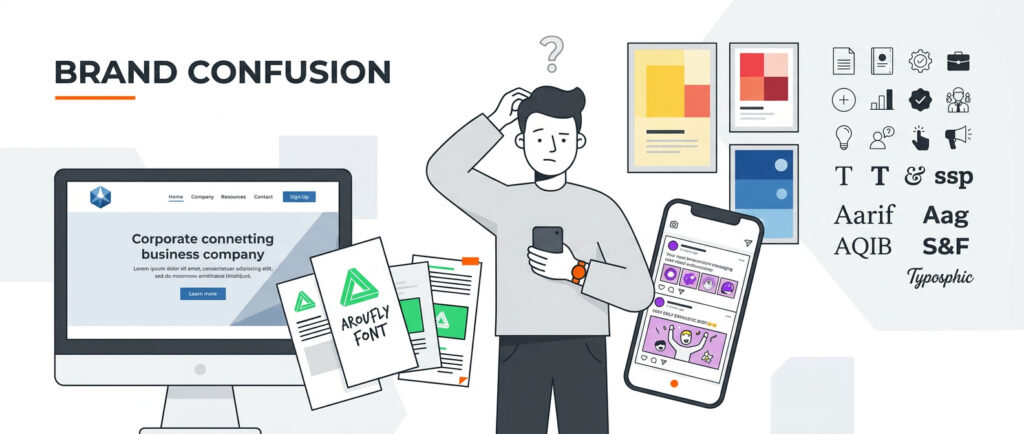
I’ve been deep in this freelance and small business game for way more than I care to admit, and let me tell you, the branding mistakes (screw-ups, really) I see every single day are enough to make you question if anyone’s actually paying the most remote attention.
Doesn’t matter if you’re just starting out or you’ve got years under your belt – hell, especially the experienced ones keep falling into these traps, probably because they’re chasing every possible paycheck or their ego is too much up their arse. I’m not here to fluff this up or make you feel better about it; these mistakes are costing people real money and opportunities, and fixing them isn’t flipping rocket science, but it does take some honest self-check and humility. Ok, let’s get into it, step by step, with some real-world examples that hopefully hit close to home.
Mistake #1: No Clear Audience Defined
This one’s the absolute killer, and I swear I spot it constantly, even from folks who’ve been running their shops for decades. They get greedy or scared, whatever, and try to market themselves to literally anyone with a pulse and a wallet. “Hey, I can help startups, big corps, moms at home, tech geeks, you name it!” But here’s the brutal part: when you spread yourself that thin, you don’t connect with anyone deeply enough to close the deal. It’s like showing up to a party and trying to be best friends with every group there, best case scenario they’ll suspect you’re an escort.
Take a freelance graphic designer I know – experienced lad, been at it 15 years. He pitches to everyone: cheap logos for small cafes, high-end branding for tech firms, even quick flyers for local bands. Result? His portfolio looks like a messy garage sale, and clients bail because they can’t tell if he’s the budget option or the premium one; and even when he does close a deal, clients are never fully confident he was the right choice. Worst part? He’s actually a hell of a designer, just a shitty entrepreneur and it shows. Meanwhile, somewhere, a newbie designer who only targets eco-friendly startups? Booked solid, charging more, because those clients see her as “their” expert.
The fix is simple but hard: pick one audience, like “mid-sized e-commerce stores looking for affordable rebrands,” and tailor everything to them. Ditch the rest – yeah, you’ll lose some leads, but the ones you get will stick and pay better. Believe me, it pays off.
Mistake #2: Screwed-Up Pricing Positioning
Similar vibe to the audience thing, but this hits right in the wallet, and even pros mess it up by offering prices from dirt cheap to sky high, hoping to snag every fish in the pond. Ugly reality? It backfires hard (no shit?!). Clients see that scattershot pricing and think you’re either desperate or shady, like a used car salesman who’ll say anything for a sale. If you’re not a massive player like Amazon, this just makes you unbelievable “Sure, $50 for basics or $5,000 for deluxe”? Sounds like a scam, even if you mean it and can really deliver, truth doesn’t matter here.
Picture a web designer, solid experience, but he lists packages from $200 quick fixes to $20,000 full builds. Clients lowball him constantly, or worse, the high-end ones ghost because it feels unreliable. Now contrast that with another dev who sticks to $1,000-$3,000 for mid-tier sites aimed at local businesses. He turns away the super-cheap requests outright, saying “That’s not my wheelhouse,” and his clients love it – they know exactly what they’re getting, no haggling, and he doesn’t burn out on crap jobs. Pricing like this also protects you: set a range, say $1500-$3,000, and own it.
Whatever you choose, low, upper-mid, ultra-premium: your customers will understand you better. Low end knows it’s efficient but not fancy; high end feels valued. Middle save a bit without skimping. Do this, and you stop wasting hours on mismatches that trash your reputation (always a pain to manage) and time (never enough innit?).
Mistake #3: Being a Jack-of-All-Trades Instead of a Specialist
I get why this happens: you’ve got skills in a few areas, and bills don’t pay themselves, so why not offer everything? But damn, it kills fricking value. Cmon! Even if you’re legit good at multiple things, clients assume the specialist is better. It’s basic human brain stuff: the guy who only does one thing seems sharper than the one juggling three. Full-stop.
Example time: a language tutor I consulted, qualified in French and German (both at Uni and at teacher-specific certifications). She marketed both, and her rates? Stuck at $25/hour because she looked like a generalist who helps your children and your office manager. Meanwhile, some French-only tutor down the street charges $50 and has a waitlist. WTF right? Brutal truth: clients think, “If she’s splitting focus, how expert can she be?” She could’ve kept doing both but split into two brands: one site/email/social for French mastery, another for German. Yeah, it’s double the work initially, but she’d charge more per niche and attract serious students.
Mistake #4: Image That’s Totally Out of Sync
Your visual and verbal vibe has to match what you’re actually selling, or it’s all confusion and lost trust. Too many go for a look that doesn’t fit their price or service, thinking it’ll make them stand out, but it just makes them look phony or messy.
This high-end consultant I knew (insurance or something like that if memory helps) – charged premium rates for contracts and strategies, but his website was all bright colours, casual memes, and “hey buddy” language. Clients expecting sophistication bounce fast, thinking it’s amateur hour.
Big companies like Virgin can pull off playful premium because they’ve got marketing armies, but for small fries? Stick to elegant fonts, muted colors, professional tone if you’re high-end. On the flip, if you’re the affordable option, don’t slap on luxury gold accents cos it’ll scream “overpromising.” I saw a budget fitness coach try that; site looked like a spa resort, but services were basic gym plans (and some unqualified diet plan). Clients felt ripped off. Match it all: cheap means friendly, approachable pics and words; premium means sleek, confident. Get this wrong, and you’re like a wolf in sheep’s clothing – no one buys in.
Mistake #5: Aiming for That “Perfect” Middle Ground Balance
Everybody loves the idea of being the fair-price, solid-service option: not cheap junk, not overpriced fluff. But pulling it off is a nightmare, and selling it is even worse. Your brand story gets muddy, hard to tell quickly, and people don’t rave about “pretty good value.”
Software tool bragging “best quality-price ratio out there.” Marketing? Vague as hell – “Reliable at a fair cost.” No one gets excited; competitors with clear low-end (“Cheapest reliable option”) or high-end (“Premium features only”) steal the show. Communicating middle ground means endless explanations in a world of -frightening- low attention span, and word-of-mouth dies because it’s not memorable. If you’re not equipped to nail the storytelling (which most of us aren’t), shift: go slightly cheaper and own “budget king” with simple, no-frills messaging, or bump up to “value premium” with extras that justify the price. Ignore this, and you’re stuck in no-man’s-land, invisible and underpaid.
Mistake #6: Inconsistent Communication Across Channels
Yeah, you gotta tweak your style per platform: more buttoned-up on LinkedIn, relaxed on Instagram, punchy on X…. but if it’s wildly different, no one recognizes you as the same brand. It’s like having multiple personalities; confuses the hell out of people.
Saw it with a small marketing agency: Website’s formal and detailed, LinkedIn matches, but Instagram’s all memes and slang, X is aggressive rants. Potential clients see one, check another, and think “Is this the same company?” Lost leads galore. Fix by keeping core elements consistent, same logo tweaks, colour palette, tone variations but not overhauls. Website professional? LinkedIn amps that; Instagram lightens it but stays on-brand. That way, a Twitter follower hits your site and goes “Yep, that’s them.” Inconsistency fragments your identity; unify it, and you build trust fast.
Mistake #7: Focusing on Features Over Problems Solved
Stop listing what your thing does; talk about the headaches it cures. We all just wanna be happy bro 🙂 Features are boring specs for most; problems solved are what clients actually care about.
Example: A SaaS guy pitches “Our app has AI integration, cloud storage, analytics dashboards.” Snooze. Clients think, “So what?” Better: “Tired of manual tracking eating your time? Our app automates it, spots issues early, and frees you up for real work.” Move from “I write blogs posts, emails, and ads” to “I fix your boring content to something people engage with and turn it into stuff that sells.” Bookings doubled. Brutal: no one wants your Harvard degree or fancy tools for the sake of it; they want their problem gone. Lead with that, or you’re just another feature-dump or fancy degree waver.
Mistake #8: Forgetting the Emotional Side
Choices aren’t cold logic; they’re gut feelings first, justified later. Decisions happen in the amygdala, pre-frontal cortex comes afterwards to justify logically a choice you’ve already made emotionally (I know, it sucks, but that’s how humans work). Your brand needs to hit emotions: relief, power, belonging, joy – or it’s forgettable.
Apple sells “Effortless cool and connection,” not processor specs (for a good reason btw 😂)
If you’re a therapist, don’t only list qualifications; evoke “Finally feel understood and lighter.” Skip emotions, and you’re a robot in a human world – no loyalty, no buzz.
Mistake #9: No Clear Structure in Offerings
Bombard clients with too many choices, and they freeze up, unhappy even if they pick. Keep it lean; fewer options mean better decisions and higher satisfaction.
Many many studies prove it – like the jam test: 24 varieties? Meh. 6? Hell yeah. And even when the very same jam was picked, in the latter case the level of satisfaction was higher. A consultant with 10 service packages confuses everyone; trim to 3 (basic, standard, premium), and conversions jump. People felt confident, not overwhelmed. Overdo options, and they bail or buy confused; simplify, and you close more and with happier clients.
Mistake #10: Brand Promise Doesn’t Match Reality
What you advertise vs. what delivers. Mismatch kills trust. Often, you think your strength is X, but clients love Y.
One company pushed “Cutting-edge innovation,” but feedback showed clients raved about “Super responsive support.” They pivoted branding to that, and retention soared. Ask happy customers: “What do you love most about us?” Even if it’s not your ego-boost (like quick emails over fancy degrees), leverage it. Ignore perception, and your brand’s a lie – clients feel duped.
Let me say this once again because I know it ain’t easy to digest, your strengths and weaknesses are rarely objective facts: clients’ perception is the only thing that matters. Makes peace with the fact that you’ve bust your arse at Yale; if you’re the guy people are happy to go to for his friendly and empathic support, leverage that. …Ok MF, mention Yale of course, but focus the leverage on what clients really love about you.
Mistake #11: Centering on One Person Over the Brand
Tying everything to you personally? Okay for pure solo gigs, but if growth’s the plan, it’s a tough ceiling to break.
Apple’s Jobs obsession caused panic post-death; releases got shredded. Think about it, a brand with such customer loyalty that we actually make fun of Apple’s blind-lovers to the point of irrationality, still lost sales and confidence in the new releases once the founder died. You might say “That’s cos the genius was him” but that certainly can’t be the whole truth, can it? Cynical as it may sound: business-wise most experts would agree that Jobs failed as a leader, at least partially, because of the dependence on him the company had. Good to Great (Jim Collins) describes as one of the core elements of level 5 leadership (the highest level) building enduring greatness, not personal fame, and successfully setting successors. Did Apple remain great anyway? Sure. Could have done it without losing millions and scaring off many clients? Yes.
In your small reality this means, for example, that if you offer time-based services like consulting without building a brand stronger than yourself, scaling through partners or collaborators later will be virtually impossible.
Even recorded video courses — which look scalable on paper — hit the same wall. Sooner or later you won’t want to record everything yourself. You’ll want multiple creators doing the heavy lifting while you earn. That only works when the focal point is the brand, not you.
And this shift has to happen early. The longer you wait, the harder it becomes. Wait long enough, and it turns from difficult to flat-out impossible.
Now go on and fix it! 🙂
If something in here exposed a weak point in your branding, deal with it now. Audience confusion, sloppy positioning, or random pricing aren’t harmless quirks: they quietly drain momentum and money.
Clear who you’re for, what you stand for, and why you cost what you cost. Then make sure every touchpoint reflects that. Branding isn’t decoration; it’s alignment. When that’s off, everything feels harder than it should.
Fix the gaps, stay consistent, and let the work compound. That’s usually more than enough to see great results in just a few months.
Well, as that piggy says “That’s all folks”. I really hope this humble article gave you a few good actionable tips and wish you to slay away with your business!